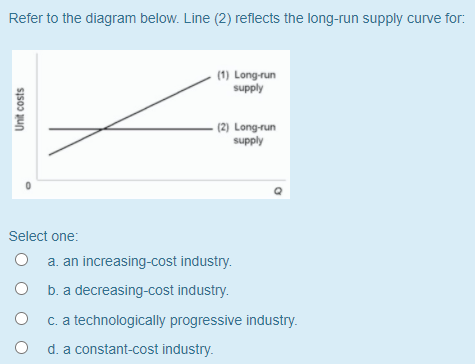
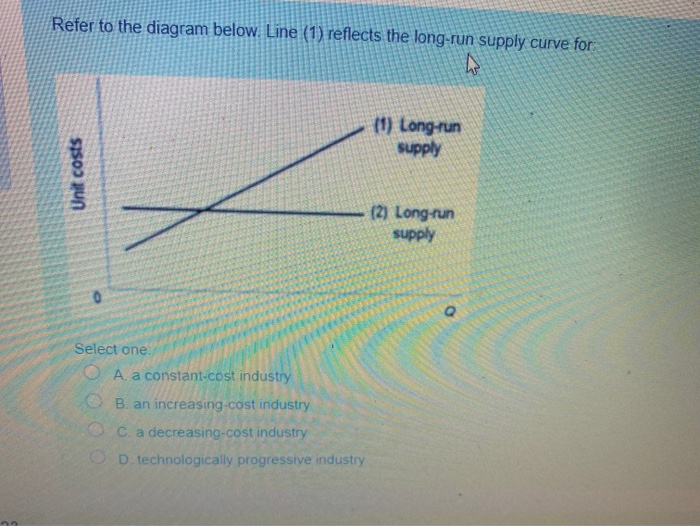
42 line (1) in the diagram reflects the long-run supply curve for
Line (1) reflects the long-run supply curve for: an increasing-cost industry. Refer to the above diagram. Line (2) reflects the long-run supply curve for: a constant-cost industry. Refer to the above diagram. Line (1) reflects a situation where resource prices: increase as industry output expands. Refer to the above diagrams which pertain to a purely competitive firm producing output q and the ... Line (1) reflects the long-run supply curve for:.
Refer to the above diagram. Line (1) reflects the long-run supply curve for: C. an increasing-cost industry.

Line (1) in the diagram reflects the long-run supply curve for
If the long-run supply curve of a purely competitive industry slopes upward, this implies that the prices of relevant resources: D. rise as the industry expands. 6. . Refer to the diagram. Line (1) reflects the long-run supply curve for: C. an increasing-cost industry. 7. . Refer to the diagram. Line (2) reflects the long-run supply curve for: 9. Line (1) in the diagram reflects the long-run supply curve for a technologically progressive industry. a decreasing-cost industry. a constant-cost; Question: 9. Line (1) in the diagram reflects the long-run supply curve for a technologically progressive industry. a decreasing-cost industry. a constant-cost The long-run supply curve for a purely competitive increasing-cost industry will be upsloping. A constant-cost industry is one in which... if 100 units can be produced for $100, then 150 can be produced for $150, 200 for $200, and so forth.
Line (1) in the diagram reflects the long-run supply curve for. Line (1) reflects the long-run supply curve for: an increasing-cost industry. Assume a purely competitive firm is maximizing profit at some output at which long-run average total cost is at a minimum. Transcribed image text: Refer to the diagram below. Line (2) reflects the long-run supply curve for: (1) Long run supply Unit costs (2) Long-run supply Select one: a. an increasing-cost industry. b. a decreasing-cost industry. c. a technologically progressive industry. d. a constant-cost industry. Line (1) reflects the long-run supply curve for. an increasing-cost industry. Refer to the above diagram. Line (2) reflects the long-run supply curve for. a constant-cost industry. Refer to the above diagram. Line (1) reflects a situation where resource prices. increase as industry output expands. The long-run supply curve for a purely competitive increasing-cost industry will be upsloping. ... Line (1) in the diagram reflects the long-run supply curve for. answer choices . a constant-cost industry. a decreasing-cost industry. an increasing-cost industry.
Line (1) reflects the long-run supply curve for: ... Refer to the diagrams, which pertain to a purely competitive firm producing output q and the industry ... Short-run and Long-run Supply Curves (Explained With Diagram) In the Fig. 24.1, we have given the supply curve of an individual seller or a firm. But the market price is not determined by the supply of an individual seller. Rather, it is determined by the aggregate supply, i.e., the supply offered by all the sellers (or firms) put together. Refer to the diagram. Line (1) reflects the long-run supply curve for: A.a constant-cost industry. B.a decreasing-cost industry. Correct C ... Refer to the diagram. Line (1) reflects the long-run supply curve for: a. a constant-cost industry. b. a decreasing-cost industry. c. an increasing-cost industry. d. a technologically progressive industry.
The long-run supply curve for a purely competitive increasing-cost industry will be upsloping. A constant-cost industry is one in which... if 100 units can be produced for $100, then 150 can be produced for $150, 200 for $200, and so forth. 9. Line (1) in the diagram reflects the long-run supply curve for a technologically progressive industry. a decreasing-cost industry. a constant-cost; Question: 9. Line (1) in the diagram reflects the long-run supply curve for a technologically progressive industry. a decreasing-cost industry. a constant-cost If the long-run supply curve of a purely competitive industry slopes upward, this implies that the prices of relevant resources: D. rise as the industry expands. 6. . Refer to the diagram. Line (1) reflects the long-run supply curve for: C. an increasing-cost industry. 7. . Refer to the diagram. Line (2) reflects the long-run supply curve for:
Supply And Demand Wikipedia

Electricity Balancing As A Market Equilibrium An Instrument Based Estimation Of Supply And Demand For Imbalance Energy Sciencedirect

Micro Economics Flashcards Quizlet
Ecb Staff Macroeconomic Projections For The Euro Area September 2021

Econ 1010 Study Guide Summer 2019 Midterm Marginal Revenue Productive Efficiency Average Cost
1

Indonesia 2019 Article Iv Consultation Press Release Staff Report And Statement By The Executive Director For Indonesia In Imf Staff Country Reports Volume 2019 Issue 250 2019
Reflections On Monetary Policy
Housing Prices And Inflation The White House
1
Solved Suppose The Economy Is In A Long Run Equilibrium A Draw The Economy S Short Run And Long Run Phillips Curves B Suppose A Wave Of Business Pessimism Reduces Aggregate Demand Show The Effect Of This
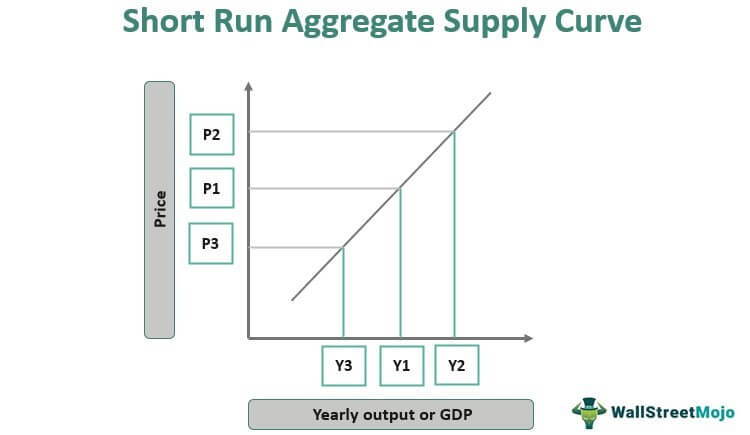
Short Run Definition Economics Examples How It Works

Deadweight Loss Wikipedia

Per Capita Income Consumption Patterns And Carbon Dioxide Emissions Vox Cepr Policy Portal
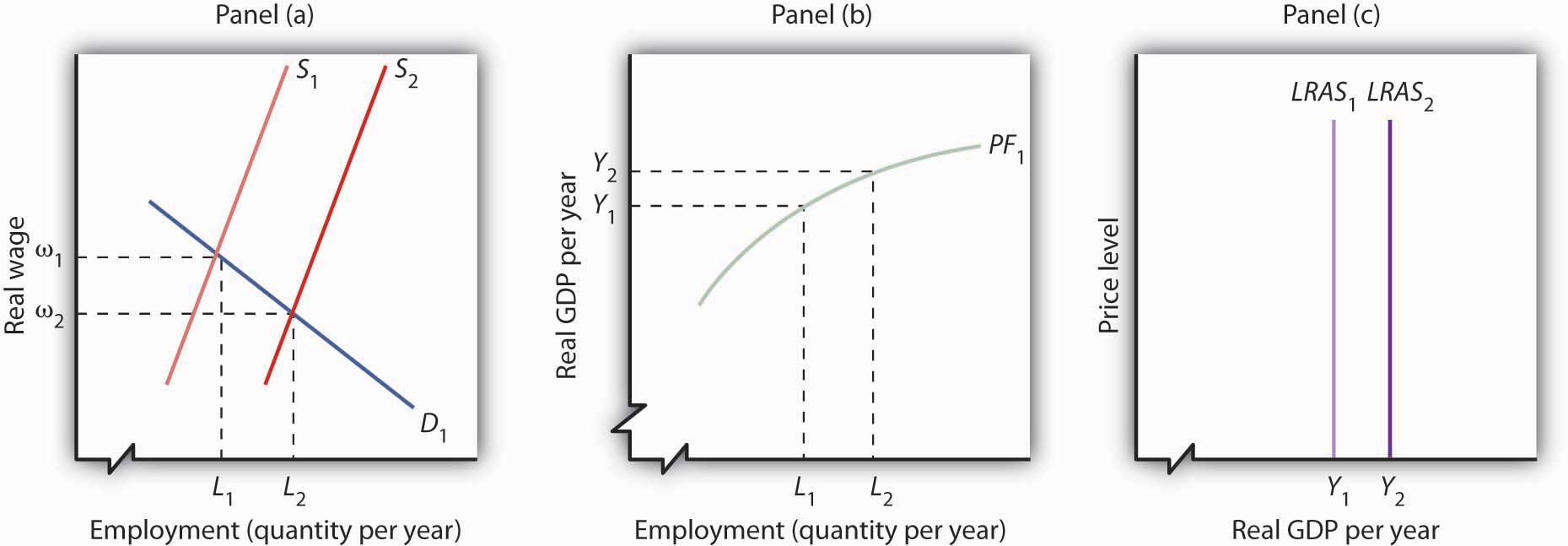
Growth And The Long Run Aggregate Supply Curve
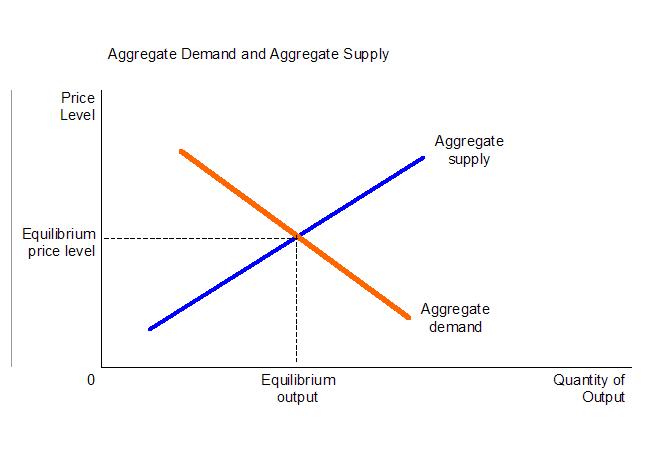
Aggregate Supply Boundless Economics

Chapter Two The Theory Of Individual Labor Supply
2
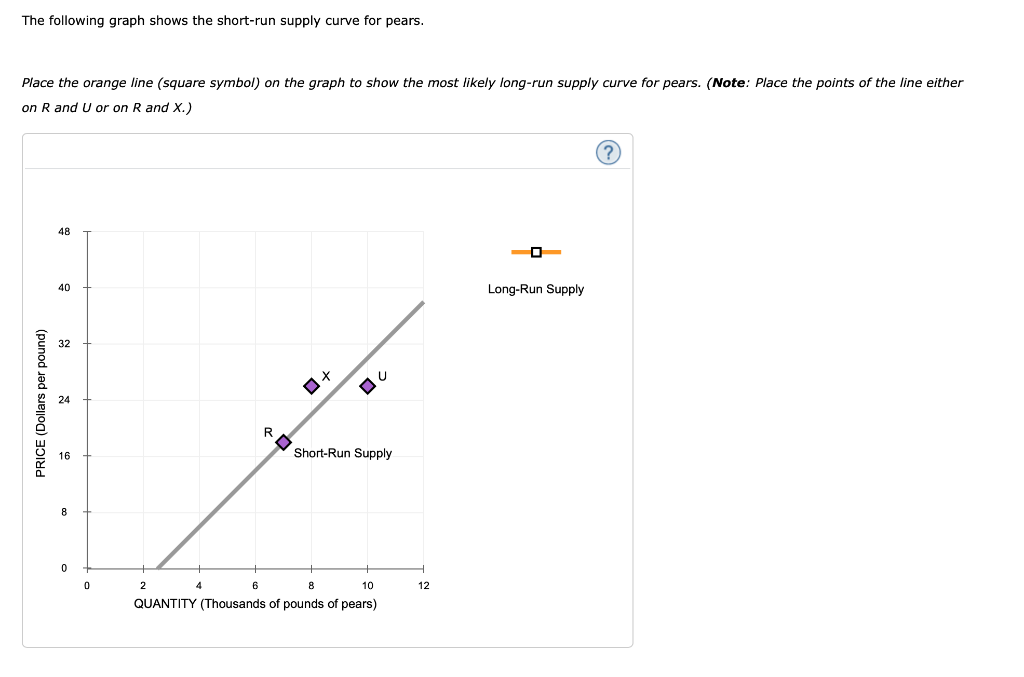
Solved The Following Graph Shows The Short Run Supply Curve Chegg Com
Solved Refer To The Diagram Below Line 2 Reflects The Chegg Com

Coronavirus Macroeconomy And Forests What Likely Impacts Latin
Long Run Supply Curve In Constant Cost Perfectly Competitive Markets Video Khan Academy

United Republic Of Tanzania In Imf Staff Country Reports Volume 2011 Issue 105 2011
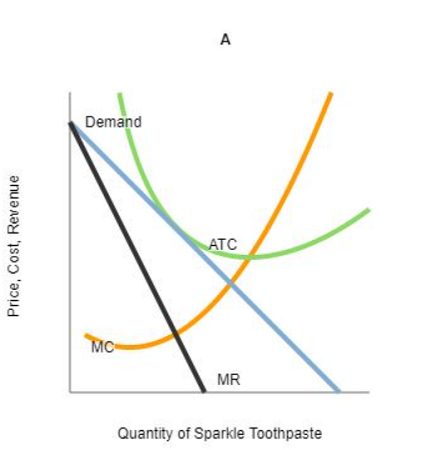
Answered Sparkle Is One Firm Of Many In The Bartleby

A Downward Sloping Labor Supply Curve The Case Of Peru Yamada 2008 Review Of Development Economics Wiley Online Library
Pure Competition
1
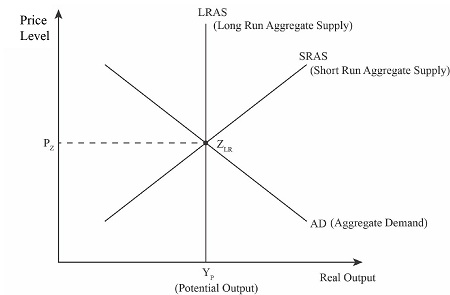
Assume That The Economy Is At Full Employment Real Output Define And Explain Economic Growth Using The Ad As Model Explain Fully And Use A Graph In Your Analysis Study Com

The Mitigating Effects Of Economic Complexity And Renewable Energy On Carbon Emissions In Developed Countries Dogan 2021 Sustainable Development Wiley Online Library

U S Uncertainty And Asian Stock Prices Evidence From The Asymmetric Nardl Model Sciencedirect
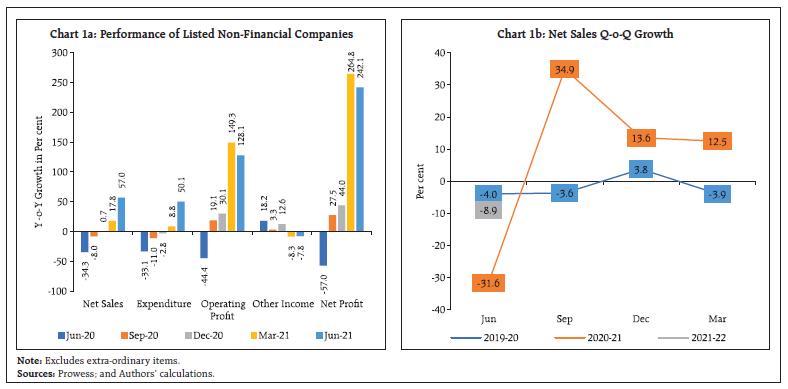
Reserve Bank Of India Rbi Bulletin
2

Unit 14 Unemployment And Fiscal Policy The Economy
2

Effect Of Exchange Depreciation On A Country S Export Price Level In Imf Staff Papers Volume 1950 Issue 001 1950
Solved Refer To The Diagram Below Line 1 Reflects The Chegg Com

An Introduction To Seismic Reflection Data Acquisition Processing And Interpretation Sciencedirect

Jvgwwvyccvk 7m
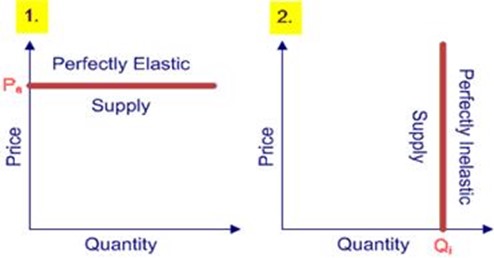
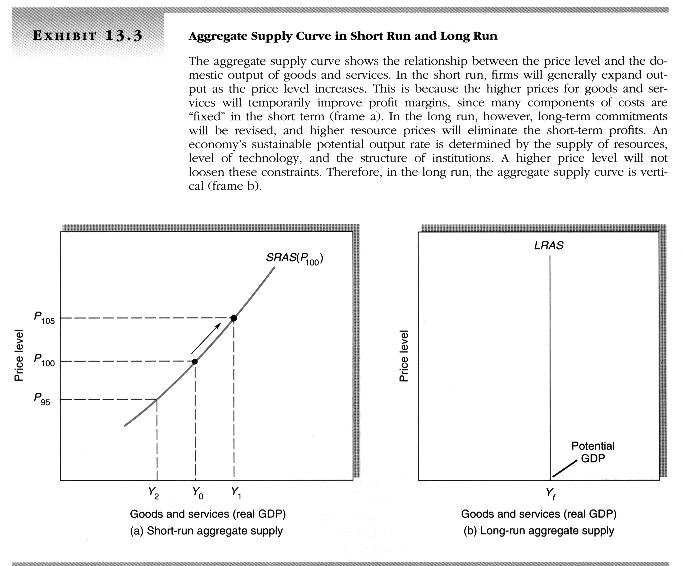
Difference Between The Long Run And Short Run Aggregate Supply As Curve Economics Tutorials
Frontiers Molecular Mechanisms Of The 1 Aminocyclopropane 1 Carboxylic Acid Acc Deaminase Producing Trichoderma Asperellum Map1 In Enhancing Wheat Tolerance To Waterlogging Stress Plant Science
Sparkle Is One Firm Of Many In The Market For Toothpaste Which Is In Long Run Equilibrium Indicate Which Of The Following Graphs Accurately Reflects Sparkle S Demand Curve Marginal Revenue Mr Curve Average Total Cost Atc
Aggregate Demand And Aggregate Supply
0 Response to "42 line (1) in the diagram reflects the long-run supply curve for"
Post a Comment